Particle in 1D Box
Quick Exam Notes
- Concept: Particle in a 1D infinite potential well.
- Wave Function: \( \psi_n(x) = \sqrt{\frac{2}{L}} \sin \left(\frac{n \pi x}{L}\right) \)
- Energy Levels: \( E_n = \frac{n^2 h^2}{8 m L^2} \)
- Quantum Number: \( n = 1, 2, 3, ... \) (no zero state)
- Key Point: Energy is quantized → increases with \( n^2 \)
- Scroll to the end of the page to explore the Interactive Visualization demo of paricle in a 1D box.
Let us consider a particle of mass m that is confined to one-dimensional region 0 ≤ x ≤ L or the particle is restricted to move along the x -axis between x=0 and x=L. Let the particle can move freely in either direction, between x=0 and x=L . The endpoints of the region behave as ideally reflecting barriers so that the particle can not leave the region. A potential energy function V(x) for this situation is shown in the figure below.
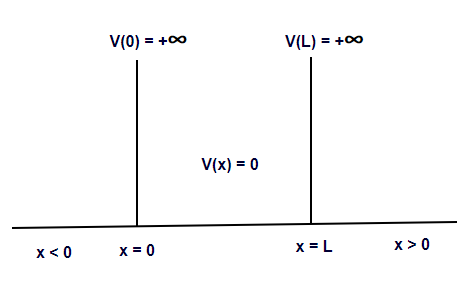
The potential energy inside the one-dimensional box can be represented as
\[ V(x) = \begin{cases} 0, & 0 \leq x \leq L \\ \infty, & x > L \end{cases} \quad \tag{1} \]Time-independent Schrödinger equation is given by
\[ \frac{\partial^2 \psi}{\partial x^2} + \frac{2m(E - V)}{\hbar^2} \psi = 0 \quad \tag{2} \]If the particle is free in a one-dimensional box, Schrödinger’s wave equation can be written as:
\[ \frac{\partial^2 \psi}{\partial x^2} + \frac{2mE}{\hbar^2} \psi = 0 \quad \tag{3} \]The general solution of the above differential equation is
\[ \psi(x) = A \sin(kx) + B \cos(kx) \quad \tag{4} \]The wave function \(\psi(x)\) should be zero everywhere outside the box since the probability of finding the particle outside the box is zero. Similarly, the wave function \(\psi(x)\) must also be zero at walls of the box because the probability density \([\psi(x)]^2\) must be continuous. Thus, the boundary conditions for this problem are:
\[ \psi(x) = 0 \quad \text{for} \quad x = 0 \] \[ \psi(x) = 0 \quad \text{for} \quad x = L \]Now applying the boundary condition in equation 4:
i) At \( x = 0 \), the wave function \( \psi(0) = 0 \). Now we get:
\[ \psi(0) = A \sin(k 0) + B \cos(k 0) \] \[ B = 0 \]Hence, substituting the value of \( B \) in Eqn 4:
\[ \psi(x) = A \sin(kx) \quad \tag{5} \]ii) At \( x = L \), the wave function \( \psi(L) = 0 \), we get:
\[ \psi(L) = A \sin(kL) \quad \tag{6} \]This equation will satisfy only for certain values of \( k \), say \( k_n \). Since \( A \) cannot be zero, we get:
\[ A \sin(k_n L) = 0 \] \[ \sin(k_n L) = \sin(n \pi) \] \[ k_n L = n\pi \] \[ k_n = \frac{n\pi}{L} \tag{7} \]Thus, for each allowed value of \( k_n \), there is a wave function \( \psi(x) \) given as:
\[ \psi_n(x) = A \sin \left( \frac{n\pi x}{L} \right) \tag{8} \]1) Eigen functions
Since the particle is inside the box of length \( L \), the probability that the particle is found inside the box is unity:
\[ \int_0^L |\psi|^2 dx = 1 \] \[ \int_0^L A^2 \sin^2 \left(\frac{n\pi x}{L}\right) dx = 1 \]Using the identity \( \cos 2x = 1 - 2\sin^2 x \), we get:
\[ A^2 \int_0^L \frac{1}{2} \left[1 - \cos \frac{2n\pi x}{L} \right] dx = 1 \] \[ \frac{A^2}{2} \left[ x - \frac{L}{2n\pi} \sin \frac{2n\pi x}{L} \right]_0^L = 1 \] i.e., \[ \frac{A^2 L}{2} = 1 \] i.e., \[ A = \sqrt{\frac{2}{L}} \]The normalized wave function is
\[ \psi_n = \left( \sqrt{\frac{2}{L}} \right) \sin \left(\frac{n\pi x}{L}\right) \tag{12} \]The wave functions \( \psi_n \) and the corresponding energies \( E_n \), which are often called eigenfunctions and eigenvalues respectively, describe the quantum state of the particle.
2) Eigen energy values
From Eqn 3 and Eqn 7, we get:
\[ k^2 = \frac{2mE}{\hbar^2} = \left( \frac{n\pi}{L} \right)^2 \]After substituting \( \hbar = \frac{h}{2\pi} \),
\[ E = \frac{n^2 h^2}{8mL^2} \tag{9} \]This is the expression of energy or eigenvalue for a particle in a box.
For different values of \( n \), energy values can be written as:
\[ \text{For } n = 1 \quad E_1 = \frac{h^2}{8mL^2} \] \[ \text{For } n = 2 \quad E = \frac{2^2 h^2}{8mL^2} = 4E_1 \] \[ \text{For } n = 3 \quad E = \frac{3^2 h^2}{8mL^2} = 9E_1 \] \[ \text{For } n = 4 \quad E = \frac{4^2 h^2}{8mL^2} = 16E_1 \tag{10} \]So the generalized form of the above equation can be written as:
\[ E = n^2 E_1 \tag{11} \]Notice that the lowest possible energy is not zero. This is referred to as zero-point energy.
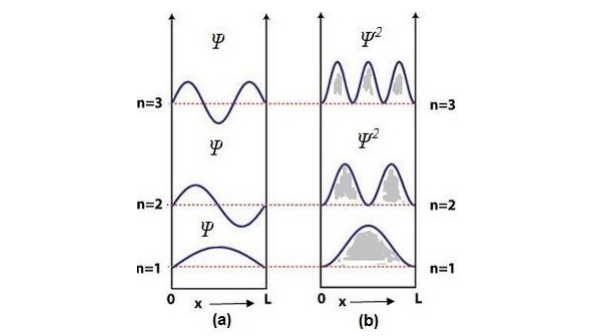
Particle in one-dimensional box a) wave function b) probability density
Interactive Visualization of Particle in a 1D Box
This visualization shows the wavefunctions and probability densities for a quantum particle confined to a one-dimensional box.
Summary
The particle in a one-dimensional box is a fundamental quantum mechanics model that explains how energy becomes quantized when a particle is confined within rigid boundaries. The Schrödinger equation gives sinusoidal wave functions and discrete energy levels, which depend on the box length and particle mass. This concept forms the basis for understanding quantum states, electron confinement in nanostructures, and the quantization of energy in quantum systems.
MCQs on Particle in a 1D Box
-
The lowest energy state (ground state) in a 1D box corresponds to:
- a) n = 0
- b) n = 1
- c) n = 2
- d) n = ∞
Answer
b) n = 1
-
The energy levels of a particle in a box vary as:
- a) n
- b) n²
- c) 1/n
- d) √n
Answer
b) n²
-
The wave function of a particle in a 1D box is:
- a) \( \psi(x) = A \cos(nx) \)
- b) \( \psi(x) = A e^{-x} \)
- c) \( \psi(x) = \sqrt{\frac{2}{L}} \sin \left(\frac{n \pi x}{L}\right) \)
- d) \( \psi(x) = \frac{1}{x} \)
Answer
c) \( \psi(x) = \sqrt{\frac{2}{L}} \sin \left(\frac{n \pi x}{L}\right) \)
-
Which of the following statements about the particle in a box is true?
- a) Energy levels are continuous
- b) Energy depends on n²
- c) Zero-point energy is zero
- d) Probability density is uniform
Answer
b) Energy depends on n²
-
The probability of finding the particle outside the box is:
- a) Maximum
- b) Minimum
- c) Zero
- d) Depends on n
Answer
c) Zero