X-ray Diffraction
X-Ray Diffraction (XRD) is a non-destructive analytical technique used to determine the crystal structure, identify phases, and analyze material properties by measuring constructive interference patterns formed when X-rays interact with the regularly spaced atomic planes in a crystalline material.
X-ray diffraction (XRD) is a non-destructive type of analytical technique which provides valuable insight about the lattice structure of a crystalline substance like unit cell dimensions, bond angles, chemical composition and crystallographic structure of natural and manufactured materials. XRD is based on the principle of constructive interference of x-rays by crystalline materials which is the sample concerned. The x-rays which are generated by a cathode ray tube (CRT) are filtered, collimated and then directed towards the sample. The interaction of the incident rays with the sample produces constructive interference of diffracted rays when conditions satisfy the Bragg’s Law as given by
\[2d \sin \theta = n \lambda \]where d is the spacing between diffracting planes, θ is the incident angle (or diffraction angle), n is an integer, and λ is the beam wavelength.
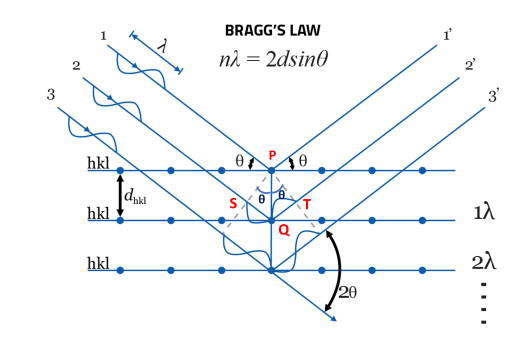
Figure 1. Schematic representation of Bragg’s law
Consider a crystal with crystal lattice planar distances d. Where the travel path length difference between the ray paths 1P1’ and 2Q2’ is an integer multiple of the wavelength, constructive interference will occur for a combination of that specific wavelength, crystal lattice planar spacing and angle of incidence.
The path difference can be written as from the Fig 1,
SQ+QT = n λ
Where SQ = dsinθ and QT = dsinθ. Hence the final the equation becomes
2d sinθ = n λ
The Bragg’s law relates the wavelength of electromagnetic radiation to the diffraction angle and the lattice spacing in a crystalline sample. These diffracted X-rays are then detected, processed and counted. By changing the geometry of the incident rays, the orientation of the centered crystal and the detector, all possible diffraction directions of the lattice should be attained.
Applications of XRD
- Determination of crystal structures and phase identification in materials science.
- Characterization of nanomaterials and nanoparticles by crystal size and lattice strain.
- Quality control in metallurgy, ceramics, and semiconductor industries.
- Analysis of thin films, coatings and powder samples.
- Research in geology, chemistry and polymer science.
Advantages of XRD
- Non-destructive technique requiring minimal sample preparation.:contentReference.
- Provides quantitative phase identification and crystal structure information.
- Fast analysis suitable for research and industrial applications.
- Applicable to a wide range of materials including powders, solids and thin films.
Related topics: Synthesis of Nanomaterials | Sol-Gel Method | Chemical Vapour Deposition