Soft and Hard Magnetic Materials
| S.No | Hard Magnetic Materials | Soft Magnetic Materials |
|---|---|---|
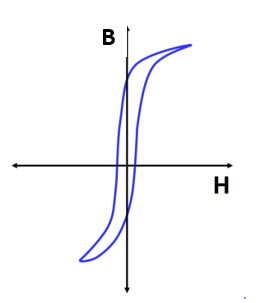
| 1 | Large hysteresis loop area | Small hysteresis loop area |
| 2 | Cannot be easily magnetized | Can be easily magnetized |
| 3 | Domain wall does not move easily and requires large H for magnetization | Domain wall moves easily and requires small H for magnetization |
| 4 | Retentivity and coercivity are large | Retentivity and coercivity are small |
| 5 | More impurities and defects | No impurities and defects |
| 6 | Examples: Alnico, Chromium steel, Tungsten steel, Carbon steel | Examples: Iron-silicon alloy, Ferrous-nickel alloy, Ferrites, Garnets |
| 7 | Uses: Permanent magnets, DC magnets | Uses: Electromagnets, Computer data storage, Transformer core |

MCQs on Soft and Hard Magnetic Materials
-
Soft magnetic materials are mainly used in:
- a) Permanent magnets
- b) Electromagnets and transformer cores
- c) Data storage devices
- d) Loudspeakers
Answer
b) Electromagnets and transformer cores
-
Hard magnetic materials are characterized by:
- a) High coercivity and high retentivity
- b) Low coercivity and low hysteresis loss
- c) High magnetic permeability
- d) Very low eddy current loss
Answer
a) High coercivity and high retentivity
-
Which of the following is an example of a soft magnetic material?
- a) Alnico
- b) Ferrites
- c) Tungsten steel
- d) Samarium–cobalt
Answer
b) Ferrites
-
Hard magnetic materials are preferred for:
- a) Temporary magnets
- b) Permanent magnets
- c) Transformer cores
- d) Inductor coils
Answer
b) Permanent magnets
-
Soft magnetic materials exhibit:
- a) Large hysteresis loop area
- b) Very low magnetic permeability
- c) Small coercive force and low hysteresis loss
- d) High eddy current loss
Answer
c) Small coercive force and low hysteresis loss