Magnetic Properties of Materials
Matters are composed of a large number of atoms. In general, the magnetic moments of the atoms are randomly oriented and the net magnetic moment in any volume of the material is zero. However, when the material is placed in an external magnetic field, a torque acts on the atomic dipoles and tries to align them parallel to the direction of the field. Thermal motion of atoms frequently changes the orientation and tries to randomize the magnetic moment.
With the increase in magnetic field strength and decrease in temperature, the alignment becomes nearly perfect and the material becomes magnetically saturated.
Magnetic Intensity (H)
When a magnetic field is applied to a magnetic material, the material gets magnetized. The actual magnetic field inside the material is the sum of the applied magnetic field and the magnetic field due to magnetization. Hence, magnetic intensity \(\vec{H}\) is defined as:
$$ \vec{H} = \frac{\vec{B}}{\mu_0} - \vec{M} $$
Here, \(\vec{B}\) is the resultant magnetic field and \(\vec{M}\) is the magnetization. The unit of \(H/)is ampere meter\(^{-1}\).
Magnetic Susceptibility ( \(\chi\) )
The intensity of magnetization of a material is directly proportional to the magnetic intensity. Thus,
$$ \vec{M} = \chi \vec{H} $$
The proportionality constant \(\chi\) is called the magnetic susceptibility. It is a dimensionless constant.
Permeability (\(\mu\))
The permeability of a material is a measure of how easily magnetic field lines can pass through it. It is defined as:
$$ \mu = \frac{B}{H} $$
Origin of Magnetization – Magnetic Dipole Moment
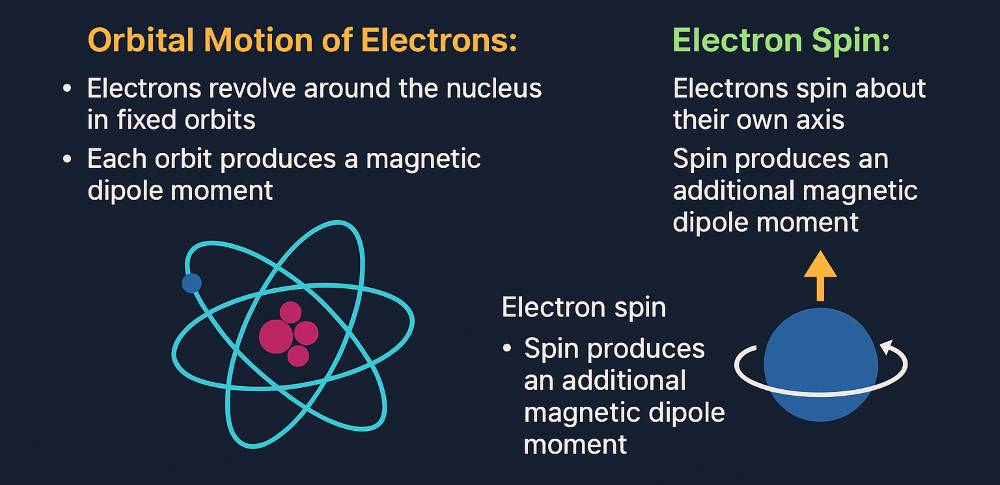
The magnetic properties of solids mainly arise from the behavior of electrons inside atoms. Electrons move in different ways, and these motions create magnetic dipole moments, which determine the magnetic nature of a material.
In an atom, the total magnetic moment comes from the following sources:
- Orbital Motion of Electrons: Electrons revolve around the nucleus in fixed orbits. Each orbit acts as a tiny current loop and produces a magnetic dipole moment. The total orbital magnetic moment of an atom is the sum of magnetic moments of all its electrons.
- Electron Spin: Each electron spins about its own axis, producing an additional magnetic dipole moment. Spin magnetic moment is stronger and plays a major role in magnetism.