Classification of Magnetic Materials
Magnetic materials are classified based on the magnetic dipole moments of their atoms. Atoms may or may not have a permanent magnetic dipole moment, and this determines their magnetic behaviour.
-
Diamagnetic materials:
The materials are made up of atoms that have no permanent magnetic dipole moment.
Examples: Bismuth, Copper, Silver. -
Some atoms or molecules have a permanent magnetic moment. These materials are further divided into
four types depending on how the atomic magnetic dipoles interact with each other:
-
If the interaction between magnetic dipoles is very weak or negligible, the material is called
paramagnetic.
Dipoles align partially when an external magnetic field is applied but return to a random
orientation when the field is removed.
Example: Aluminum, Platinum. -
Dipoles interact strongly and align in the same direction, even without an external magnetic field.
Such materials are called ferromagnetic.
They show strong magnetism and can become permanent magnets.
Example: Iron, Cobalt, Nickel. -
Neighboring dipoles align in exactly opposite directions, giving antiferromagnetic
behavior.
The dipoles have equal magnitude, so they cancel each other, resulting in zero net magnetization.
Example: Manganese Oxide (MnO). -
Dipoles align in opposite (antiparallel) directions, but their magnitudes are not equal.
So, they do not cancel completely and produce a net magnetization.
These materials are called ferrimagnetic.
Example: Magnetite (Fe₃O₄).
-
If the interaction between magnetic dipoles is very weak or negligible, the material is called
paramagnetic.
Dipoles align partially when an external magnetic field is applied but return to a random
orientation when the field is removed.
| S.No. | Diamagnetic | Paramagnetic | Ferromagnetic |
|---|---|---|---|
| 1 | No magnetic moments | Randomly oriented magnetic moments | Domains with parallel magnetic moments |
| 2 | Negative susceptibility | Positive, less than 1 | Large and positive susceptibility |
| 3 | Weakly repelled by magnetic field | Weakly attracted | Strongly attracted |
| 4 | Less field lines inside | More field lines inside | Field lines concentrated |
| 5 | No hysteresis | No hysteresis | Shows hysteresis |
| 6 | Bismuth, Mercury, Silver | Platinum, Chromium, Aluminum | Iron, Cobalt, Nickel |
| 7 | 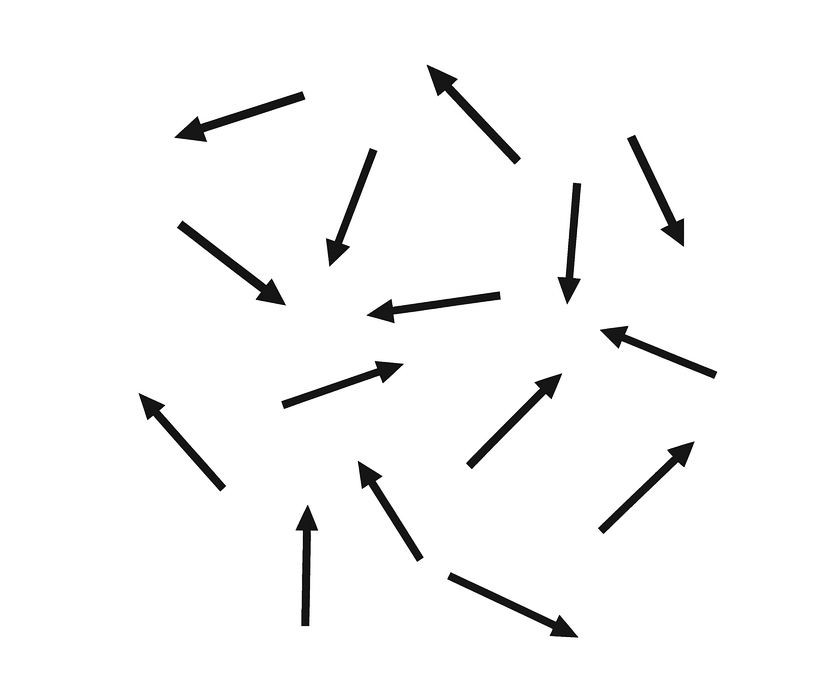 |
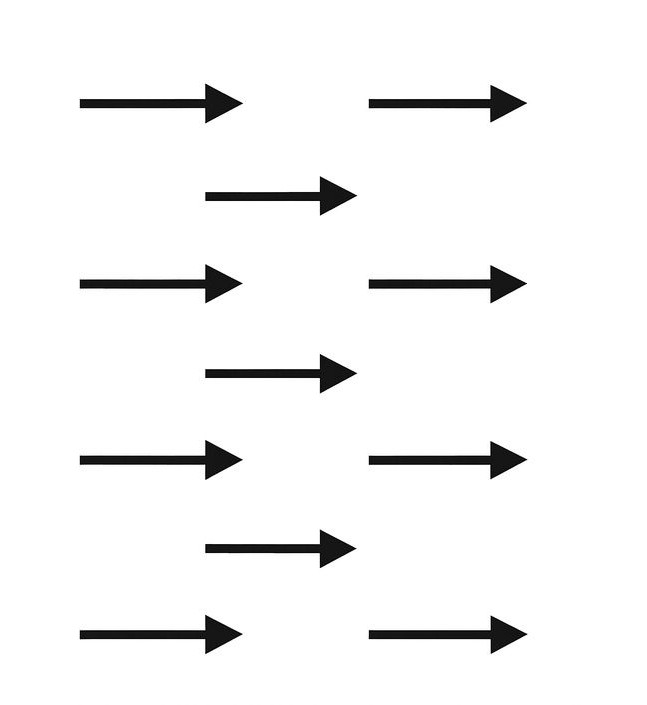 |
MCQs on Classification of Magnetic Materials
-
Diamagnetic materials are those in which:
- a) Atoms have strong permanent dipole moments
- b) Magnetic dipoles align spontaneously
- c) Atoms have no permanent magnetic dipole moment
- d) Magnetic dipoles align opposite but unequal
Answer
c) Atoms have no permanent magnetic dipole moment
-
When magnetic dipoles align strongly in the same direction, the material is:
- a) Diamagnetic
- b) Paramagnetic
- c) Ferromagnetic
- d) Antiferromagnetic
Answer
c) Ferromagnetic
-
In antiferromagnetic materials:
- a) Dipoles align randomly
- b) Dipoles align in opposite directions with equal magnitude
- c) Dipoles align parallel and strong
- d) Dipoles align opposite with unequal magnitude
Answer
b) Dipoles align in opposite directions with equal magnitude
-
Ferrimagnetic materials differ from antiferromagnetic materials because:
- a) They show no net magnetization
- b) They have unequal opposite dipole moments, giving net magnetization
- c) They repel magnetic fields strongly
- d) They behave like superconductors
Answer
b) They have unequal opposite dipole moments, giving net magnetization
-
Paramagnetic materials:
- a) Are strongly attracted by magnetic fields
- b) Are repelled by magnetic fields
- c) Are weakly attracted due to small permanent dipole moments
- d) Cannot be magnetized at all
Answer
c) Are weakly attracted due to small permanent dipole moments