Weiss Theory of Ferromagnetism
In ferromagnetic materials, the magnetic moments of atoms align perfectly with an applied magnetic field when magnetized. But in their normal unmagnetized state, ferromagnetic materials behave differently.
Magnetic Domains
Entire ferromagnetic material volume splits into large number of small regions of spontaneous magnetization called the domains. Inside each domain, all atomic magnetic moments point in the same direction. Each domain has a strong net magnetic moment. But different domains point in different directions, canceling each other so that the net magnetic monent of the entire body equals to zero.
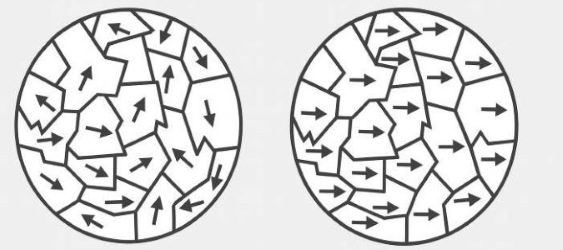
Figure 1. a) Magnetic domains in demagnetized ferromagnetic material b) Domain configuaration in a magnetized body.
Magnetic Field is Applied
When a magnetic field H is applied to a ferromagnet, magnetization proceeds by two main processes:
- By motion of domain walls (Domain growth)
In weak fields, domains whose magnetization already points near the field direction grow at the expense of unfavourable domains. This happens by sidewise motion of the domain walls. With increasing H, the favoured domains grow more and may eventually make the whole crystal a single domain. - By rotation of domains
In stronger fields, even the magnetization inside domains rotates to align with the applied field. Rotation reduces the magnetic energy and helps reach saturation.

Figure 2. Magnetic domain growht and rotation in the presence of applied magnetic field.
MCQs on Weiss Theory of Ferromagnetism
-
According to Weiss theory, ferromagnetic materials contain small regions called:
- a) Domains
- b) Dipoles
- c) Flux tubes
- d) Magnetic shells
Answer
a) Domains
-
The strong internal field assumed by Weiss to align magnetic moments is known as:
- a) Hysteresis field
- b) Exchange field
- c) Curie field
- d) Demagnetizing field
Answer
b) Exchange field
-
At temperatures above the Curie temperature, a ferromagnetic material becomes:
- a) Diamagnetic
- b) Paramagnetic
- c) Antiferromagnetic
- d) Superconducting
Answer
b) Paramagnetic
-
Weiss theory explains ferromagnetism primarily based on:
- a) Motion of free electrons
- b) Formation of magnetic monopoles
- c) Alignment of atomic magnetic moments within domains
- d) Thermal vibrations of atoms
Answer
c) Alignment of atomic magnetic moments within domains
-
Which statement is TRUE regarding Weiss domains?
- a) All domains naturally point in the same direction
- b) Domains disappear at absolute zero
- c) Domains align in the direction of the applied magnetic field
- d) Domains are unaffected by temperature
Answer
c) Domains align in the direction of the applied magnetic field