LASER
Aim
Determination of the wavelength of a given source of Laser light using plane transmission grating.
Apparatus
- Plane Diffraction Grating
- Grating Stand
- Ammeter
- LASER Source
- Meter Scale
Pre-Lab Questions
- What is the difference between spontaneous emission and stimulated emission?
In spontaneous emission, atom in the excited state emits radiation even in the absence of any incident radiation.
In stimulated emission, an incident signal of appropriate frequency triggers an atom in an excited state to emit radiation - State the diffraction grating equation and define each term in it
\[ \lambda = \frac{2.54 \times sin \theta}{n \times N} \]
Where- n: Order of diffraction (integer: 1, 2, 3, ...), indicating the diffraction maximum.
- \( \lambda \): Wavelength of the incident light (in meters), the property to be determined.
- \( \theta \): Angle of diffraction (in degrees or radians), the angle at which the diffracted light forms a maximum relative to the normal.
- N: Number of lines per inch on the plane diffraction grating
- What is an optical resonator?
An optical resonator is a system, typically consisting of two or more mirrors, that confines and amplifies light by reflecting it back and forth. It is a key component in lasers, enhancing stimulated emission to produce coherent light. - Why is population inversion necessary for Laser action?
Population inversion is necessary for laser action because it ensures more atoms are in an excited state than in a lower energy state, enabling stimulated emission to dominate over absorption. - What would happen to the diffraction pattern if a white light source were used instead of a laser?
If a white light source is used instead of a laser, the diffraction pattern would show multiple overlapping spectra (rainbow-like patterns) for each diffraction order instead of distinct spots. - What is a diffraction grating, and how does a plane transmission grating produce a diffraction pattern?
A diffraction grating is an optical device with many closely spaced slits or lines that diffract light into multiple directions, producing interference patterns. A plane transmission grating produces a diffraction pattern by allowing light to pass through its transparent slits, where each slit acts as a secondary wave source, causing constructive interference at specific angles according to the grating equation \( n\lambda = d \sin \theta \), resulting in bright maxima (spots or lines) on a screen. - How would the diffraction pattern change if white light was used instead of laser light?
If white light is used instead of laser light, the diffraction pattern will show a continuous spectrum (rainbow) for each order instead of sharp spots. This is because white light contains multiple wavelengths, and each wavelength diffracts at a different angle, producing colored fringes rather than single bright spots.
Theory
A plane transmission grating is a transparent plate with a large number of equally spaced slits (grating lines). When laser light passes through the grating, it diffracts, producing a series of bright spots (diffraction orders) due to constructive interference. The diffraction grating equation is: \[ \lambda = \frac{2.54 \times \sin \theta}{n \times N} \] Where:- \(n \) = order of diffraction (1, 2, 3, ...),
- \( \lambda \) = wavelength of the laser light (to be determined),
- N = Number of lines per inch on the plane diffraction grating
- \( \theta \) = angle of diffraction for the \(n^{th} \) order.
Diagram
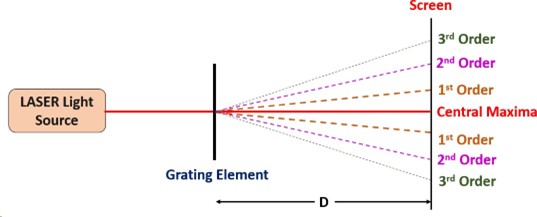
Working Formula
The wavelength of the laser light can be calculated using the formula: \[ \lambda = \frac{2.54 \times \sin \theta}{n \times N} cm \] Where- \( \lambda \) is the wavelength of the laser light in cm
- N is the number lines per inch on the plane diffraction grating
- n is order of diffraction
- \( \theta \) = angle of diffraction for the \(n^{th} \) order.
Calculations
After calculating wavelength for each and individual order of diffraction, the average value can be calculated as \[ \lambda = \frac{\lambda_1+\lambda_2+\lambda_3+\lambda_4+\lambda_5}{5} cm \] \[ \lambda = \frac{6.90 \times 10^{-5}+6.85 \times 10^{-5}+6.74 \times 10^{-5} + 7.05 \times 10^{-5}+6.95 \times 10^{-5}}{5} cm \] \[ \lambda = 6.898 \times 10^{-5} \times 10^{-2} m \] \[ \lambda = 689.8 \times 10^{-7} \times 10^{-2} m \] \[ \lambda = 689.8 nm \]Procedure
- Position the Grating: Place the plane transmission grating directly in front of the laser beam, ensuring the beam strikes the grating perpendicularly (normal incidence).
- Set the Screen Distance: Position a screen 30 cm away from the grating to capture the diffraction pattern.
- Observe the Diffraction Pattern: After passing through the grating, the laser light will diffract, producing a central maximum (bright spot) and additional diffraction maxima (spots) of various orders on the screen.
- Mark Diffraction Spots: Use graph paper attached to the screen to accurately mark the positions of the diffraction spots on both the left and right sides of the central maximum.
- Measure Spot Distances: For each diffraction order, measure the distance from the central maximum to the diffraction spot on the left side (\( d_1 \)) and the right side (\( d_2 \)) using a ruler.
- Record Measurements: Tabulate all measured distances (\( d_1 \) and \( d_2 \)) for each diffraction order in a table to calculate the wavelength of the laser light using the diffraction grating equation.
Observation Table
| Diffraction Order (n) | Distance \( d_1 \) (cm) | Distance \( d_2 \) (cm) | Mean Distance \( d = \frac{d_1 + d_2}{2} \) | \( \sin \theta = \frac{d}{\sqrt{d^2 + D^2}} \) | \( \lambda = \frac{2.54 \times \sin \theta}{n \times N} \) (cm) |
|---|---|---|---|---|---|
| 1 | |||||
| 2 | |||||
| 3 | |||||
| 4 | |||||
| 5 |
Precautions
- Diffraction grating should be handled with extra care.
- Laser light is dangerous to human tissues and skin. Avoid direct contact of Laser light with eyes.
- Maintain proper alignment of Laser source with grating stand for better results.
Applications
- Optical Device Testing
- Laser Technology Development
- Spectroscopy
- Wavelength Calibration
Post-Lab Questions
- Explain in short the basic principle of semiconductor diode LASER.
A semiconductor diode LASER works on the principle of electroluminescence and stimulated emission, where electrons and holes recombine in the active region to emit coherent light. It requires a forward-biased p-n junction to produce population inversion and light amplification - If the distance between the grating and the screen is doubled, how would this affect the position of the diffraction spots on the screen? Derive the relationship.
Doubling the distance between the grating and the screen increases the distance of diffraction spots from the central maximum. The spot positions are directly proportional to the screen distance. - What do you mean by meta-stable state?
A meta-stable state is an excited energy state of an atom where electrons remain for a relatively longer time before returning to the ground state. This delayed transition enables stimulated emission, which is essential for laser action. - If you repeated the experiment with a different laser (e.g., a green laser instead of a red laser), how would the diffraction pattern change? Predict the new wavelength range.
Using a green laser instead of a red laser (which has a shorter wavelength), the diffraction spots will appear closer to the central maximum, since angle θ decreases as \( \lambda \) decreases. Typical green laser wavelengths range from 520 nm to 550 nm (compared to red lasers, which are around 630–680 nm). - What are the commonly used pumping mechanism for laser action?
The commonly used pumping mechanisms for laser action are:- Optical pumping – using light (e.g., flash lamps or other lasers).
- Electrical pumping – using electric current or discharge (common in semiconductor and gas lasers).
- Chemical pumping – using energy from chemical reactions.
- Why is monochromatic light (like laser light) preferred in this experiment?
Monochromatic light is preferred because it has a single wavelength, which produces clear and distinct diffraction spots. This allows for accurate measurement of diffraction angles and precise calculation of the wavelength using the grating equation. - Can this method be used to determine the wavelength of unknown light sources?
Yes, this method can be used to determine the wavelength of unknown light sources, as long as the light is monochromatic or can be treated as a single wavelength.
Outcomes
- Calculate the value of wavelength of the Laser.
- Understand the fundamentals of the Laser.
- Understand the basics of diffraction phenomenon.