Newton's Rings Experiment
Experimental Arrangement
A plane-convex lens (L) of large radius of curvature (R) is placed on a plane glass plate (P) with its convex surface in contact with glass plate. The convex surface touches glass plate at C, and an air film of increasing thickness is formed between the convex surface and glass plate from C to L. Light rays from an extended monochromatic source [sodium vapour lamp placed behind a slit] are made to incident on a glass plate G, placed at an angle of 45° to the vertical shown in Figure. This glass plate reflects the light rays and makes the light rays to be incident normally on the convex surface of the lens. A part of these rays are reflected by the convex surface and remaining part transmits to the plane glass plate. The plane glass plate reflects these rays and they pass through the lens and interfere with the light rays reflected by convex surface. As a result Newton’s rings are formed. These rings are viewed using travelling microscope as shown in Figure 1.
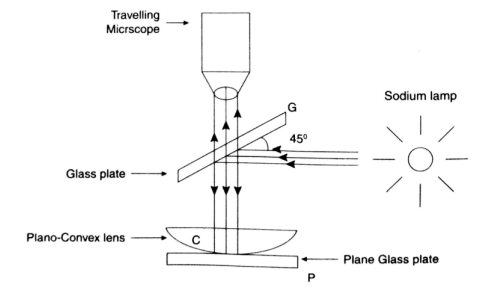
Figure 1. Newton's rings experiement setup
Theory
The transmitted ray is reflected by back the lower surface of the lens and transmits into air along 1. A part of this ray BC gets transmitted long CD to the upper surface of the glass plate P and gets reflected and transits through lens along 2, shown in Figure 2. These two rays 1 and 2 are obtained from sameray AB. Hence, they interfere with each other forming Newton’s rings.
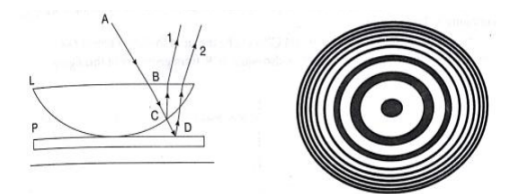
Figure 2. Reflected rays in Newton's rings
The path difference between these two rays is
\[ \Delta = 2t + \frac{\lambda}{2} \tag{1} \] For bright circular ring, \[ 2t + \frac{\lambda}{2} = n\lambda \] \[ 2t = \frac{(2n - 1) \lambda}{2} \tag{2} \] For dark circular ring, \[ 2t + \frac{\lambda}{2} = (n + \frac{1}{2})\lambda \] \[ 2t = n\lambda \tag{3} \]From equations 2 and 3, it is evident that the formation of bright and dark depends on the thickness of air film between the convex and the glass plate.
From the above figure, Applying Pythagoras theorem to \( \Delta ABC \),
\[ R^2 = (R - t)^2 + r^2 \tag{4} \] \[ 2Rt = t^2 + r^2 \tag{5} \]Because t is very small, so neglecting \( t^2 \)
\[ 2t = \frac{r^2}{R} \tag{6} \]For bright ring,
Comparing 2 and 6,
\[ \frac{r^2}{R} = \frac{(2n - 1) \lambda}{2} \tag{7} \] \[ r^2 = \frac{(2n - 1) \lambda R}{2} \tag{8} \] \[ r = \sqrt{\frac{(2n - 1) \lambda R}{2}} \tag{9} \]Diameter
\[ D = 2r = 2\sqrt{\frac{(2n - 1) \lambda R}{2}} \tag{10} \] \[ D \propto \sqrt{2n - 1} \tag{11} \]where \( r \) is the radius of the Newton’s ring, \( R \) is the radius of curvature of lens, \( n \) is the number of Newton’s ring and \( \lambda \) is the wavelength of monochromatic light.
For dark ring,
Comparing 3 and 6,
\[ \frac{r^2}{R} = n \lambda \tag{12} \] \[ r = \sqrt{n \lambda R} \tag{13} \]where \( n = 0, 1, 2, 3, \ldots \)
Diameter,
\[ D = 2r = 2\sqrt{n \lambda R} \tag{14} \] \[ D \propto \sqrt{n} \tag{15} \]Applications of Newton’s rings
Determination of wavelength of Sodium light using Newton’s rings
Let R be the radius of curvature of the lens and λ be the wavelength of the monochromatic source, Dn is the diameter of the nth ring, Dn+p is the diameter of the (n+p)th ring. D2n = 4nλR and D2(n + p) = 4(n + p)λR
\[ D_{n+p}^2 - D_n^2 = 4p \lambda R \tag{16} \] \[ \lambda = \frac{D_{n+p}^2 - D_n^2}{4pR} \tag{17} \]Using the above formula, wavelength of the monochromatic source can be determined.