Electrnoic, Ionic and Orientation Polarization
1. Electronic Polarization
Electronic polarization is the displacement of the electron cloud and the positively charged nucleus of an atom in opposite directions when an external electric field is applied, resulting in the formation of an induced electric dipole inside the atom.
In the absence of an external electric field, an atom has no dipole moment because the centres of positive charge (nucleus) and negative charge (electron cloud) coincide. When an electric field E is applied, the electron cloud shifts slightly opposite to the field while the nucleus shifts slightly along the field. This displacement separates the centres of positive and negative charge and produces an induced dipole moment p, which is directly proportional to the applied field (p ∝ E). A Coulomb restoring force develops between the displaced charges and opposes further separation, establishing an equilibrium. Electronic polarization occurs very rapidly (≈ 10−14–10−15 s) and is essentially independent of temperature.
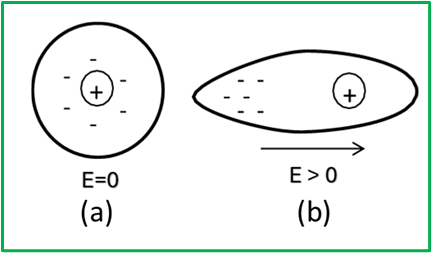
Figure1. Electric Field Lines Diagram
2. Ionic Polarization
Ionic polarization is the displacement of cations and anions in opposite directions when an external electric field is applied to an ionic dielectric, resulting in the formation of ionic dipoles inside the material.
In the absence of an external electric field, cations and anions in an ionic dielectric are arranged in a perfectly regular and periodic pattern in all directions. Although each ion interacts with neighbouring oppositely charged ions, the dipole moments cancel out due to the symmetry of the arrangement. As a result, the net dipole moment of the dielectric is zero even though it contains ionic dipole structures.
When an external electric field E is applied, the cations shift slightly in the direction of the field, while the anions shift in the opposite direction. This opposite displacement breaks the symmetry, causing the dipole moment along the direction of the field to become larger than dipole moments in other directions. Hence, a net dipole moment is developed inside the dielectric. The separation between ions is directly proportional to the applied electric field strength (E).

Figure 2. Ionic Polarization
3. Orientation Polarization
Orientation polarization is the polarization that occurs due to the rotation and alignment of permanent molecular dipoles in the direction of the applied electric field.
In materials containing polar molecules such as H2O or HCl, each molecule already possesses a permanent dipole moment due to asymmetric charge distribution. In the absence of an electric field, these dipoles are oriented randomly because of thermal agitation, resulting in zero net dipole moment at the macroscopic level.
When an external electric field E is applied, these permanent dipoles experience a torque that tends to rotate them toward the field direction. As more dipoles partially or fully align with the field, a net dipole moment develops inside the dielectric. This process is called orientation polarization. However, thermal motion opposes this alignment. Therefore, orientation polarization is highly temperature dependent. Higher temperatures reduce the degree of alignment, and therefore reduce the magnitude of polarization.

Figure 3. Orientation Polarization