Dielectric Properties of Materials
1. Electric Field & Direction
The electric field (E) represents the force experienced by a unit positive charge placed at a point. The direction of the electric field is always taken as the direction of the force on a positive test charge, which means it points from the positive charge toward the negative charge. Electric field lines never intersect, and the density of these lines indicates the strength of the field (denser lines → stronger electric field).

Figure1. Electric Field Lines Diagram
2. Insulator & Dielectric Material
An insulator is a material that does not allow the free movement of electric charges. A dielectric is a special type of insulator that becomes polarized when placed in an electric field. Dielectrics store electric energy by aligning internal charges.
3. Electric Dipole
An electric dipole consists of two equal and opposite charges separated by a small distance. It is the basic unit of dielectric polarization and plays an important role in understanding how dielectrics respond to electric fields.
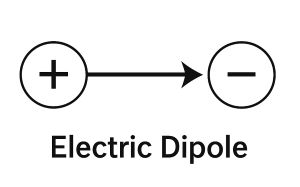
Figure 2. Electric Dipole Diagram
4. Dipole Moment
The dipole moment (p) is a measure of the strength of an electric dipole and is given by:
\[ p = q\times 2a\]Its direction is always taken from the negative charge to the positive charge. Dipole moment helps quantify the polarization capability of molecules.
Dipole Moment Diagram
5. Polar & Non-Polar Dielectrics
Polar dielectrics have a permanent dipole moment due to asymmetric charge distribution (e.g., H2O, NH3). Non-polar dielectrics do not have a permanent dipole moment; they develop temporary dipoles only when an external field is applied (e.g., O2, N2).
6. Polarization
Polarization refers to the alignment of electric dipoles inside a dielectric material when an external electric field is applied. This alignment reduces the effective electric field inside the dielectric.

Figure 3. Polarization Diagram
7. Dielectric Susceptibility
Dielectric susceptibility (χe) measures how easily a dielectric material can be polarized. Materials with a higher χe become more polarized under the same electric field.