He-Ne Laser: Construction, Working, Diagram and Applications
Quick Exam Notes
- Type: Gas laser
- Active Medium: Helium–Neon gas mixture (ratio 10:1)
- Wavelength: 632.8 nm (red region)
- Pumping Method: Electrical discharge in gas tube
- Applications: Barcode scanners, holography, optical communication, lab demonstrations
Construction of He-Ne Laser
The first gas laser to be operated successfully was the He–Ne laser. The He– Ne laser consists of a long and narrow discharge tube (diameter 2 - 8 mm and length 10–100 cm) which is filled with helium and neon with typical pressures of 1 torr and 0.1 torr (1 torr = 1mm Hg). Figure 1 shows the schematic diagram of a typical He-Ne laser. Electrical discharge mechanism is used to pump atoms from ground state.
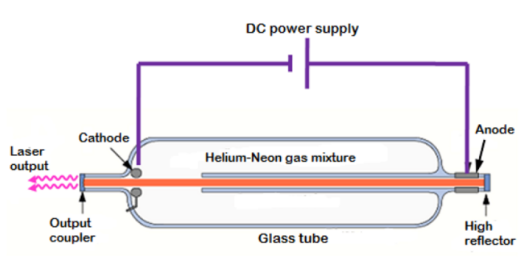
Figure 1. Construction of a He-Ne laser
Working principle of He-Ne laser
- When an electrical discharge is applied to the gas tube, fast-moving electrons collide with helium and neon atoms.
- The helium atoms tend to accumulate at levels F2 and F3 due to their long lifetimes of 10−4 s and 5x10⁻⁶ s, respectively.
- Since the levels E4 and E6 of neon atoms have almost the same energy as F2 and F3 of He atom, excited helium atoms colliding with neon atoms in the ground state can excite the neon atoms to E4 and E6.
- The pressure of helium is ten times that of neon, the levels E4 and E6 of neon are selectively populated as compared to other levels of neon.
- Transition between E6 and E3 releases coherent photon at 632.8 nm. These photons bounce between mirrors, undergo stimulated emission, and get amplified.The partially reflecting mirror allows a stable red laser beam to emerge as output
- Neon atoms de-excite through spontaneous emission from E3 to E2.
- The atoms from E2 level relax back to the ground level mainly through collisions with the walls of the tube.

Figure 2. Energy diagram of He-Ne laser
Applications of He-Ne laser
- Barcode scanners
- Non-contact measuring and monitoring
- Blood analysis
- Particle counting and food sorting
- Tool alignment
Advantages of He–Ne Laser
- Produces a stable, coherent, and monochromatic beam.
- Long operational life with continuous output.
- Cost-effective and widely available.
Limitations of He–Ne Laser
- Low power output compared to solid-state lasers.
- Large and bulky setup due to discharge tube.
- Operates at limited wavelengths (mainly 632.8 nm).
Summary
A He–Ne laser is a gas laser that uses a helium–neon mixture inside a discharge tube with mirrors at both ends. Excited helium atoms transfer energy to neon atoms, producing population inversion. Stimulated emission in neon releases a stable red beam at 632.8 nm, widely used in education, holography, and communication.
MCQs on He–Ne Laser
-
The active medium of a He–Ne laser consists of:
- a) Only Neon gas
- b) Only Helium gas
- c) A mixture of Helium and Neon gases
- d) Argon gas
Answer
c) A mixture of Helium and Neon gases
-
The most common emission wavelength of a He–Ne laser is:
- a) 1064 nm
- b) 694.3 nm
- c) 632.8 nm
- d) 1550 nm
Answer
c) 632.8 nm
-
In a He–Ne laser, population inversion is achieved by:
- a) Direct excitation of Neon atoms
- b) Optical pumping with flash lamps
- c) Energy transfer from excited Helium atoms to Neon atoms
- d) Spontaneous emission
Answer
c) Energy transfer from excited Helium atoms to Neon atoms
-
A He–Ne laser is classified as a:
- a) Solid-state laser
- b) Semiconductor laser
- c) Gas laser
- d) Dye laser
Answer
c) Gas laser
-
A common application of the He–Ne laser is:
- a) Tattoo removal
- b) Barcode scanning and alignment
- c) Optical fiber amplification
- d) Metal cutting
Answer
b) Barcode scanning and alignment