One day, I was watching a political debate on a TV show, the panelists were used to discuss the article 14, Freedom of speech, equality, etc. I was not aware of those words, then I realized that studying the constitution of India is mandatory being a citizen of India. The average Indian is not aware of the constitution of India because he may not be interested or the resources may not push him to study politics. If you are familiar with the constitution of India I am sure you will be confident enough to discuss Indian politics. This article helps you to get some basics of the constitution of India. I am also planning to write another article on the Indian Penal Code (IPC), it is the official criminal code of India. In this post, I will briefly explain about the constitution of India and how the Government of India was established.
The constitution of India is the longest constitution in the world written by Dr. Ambedkar which contains 448 articles in 25 parts, 12 schedules, and 104 amendments. The constitution of India declared as passed on on 14th November 1949 with the signature of the President of the Assembly and came into force on 26 January 1950. This day we celebrate as Republic day of India. The Constitution of India is the largest constitution written by hand and it took almost 2 years, 11 months and 18 days.
WE THE PEOPLE OF INDIA, having solemnly resolved to constitute India into a SOVEREIGN SOCIALIST SECULAr DEMOCRATIC REPUBLIC and secure to all its citizens: JUSTICE, social, economic and political; LIBERTY of thought, expression, belief, faith, and worship; EQUALITY of status and opportunity; and to promote among them all; FRATERNITY assuring the dignity of the individual and the unity and integrity of the Nation: IN OUR CONSTITUENT ASSEMBLY, this twenty-sixth day of November 1949, do HEREBY ADOPT, ENACT AND GIVE TO OURSELVES THIS CONSTITUTION.
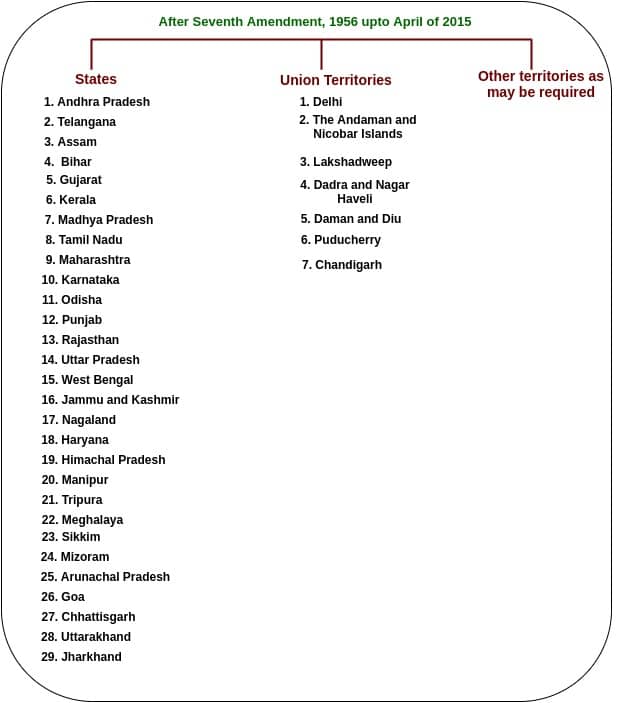
Article 1: Union of India and the members of the union. Article 2: Admission or establishment of new states. Article 3:
Article 4: Any law may make supplemental, incidental and consequential provisions for making itself effective and may ammend the First and Fourth Schedules of the Constitution.
Citizenship is a status of a citizen (person) recognized by the constitution of India. Article 5:
Article 6:
Article 7: A person who migrated from India to Pakistan after the 1 March 1947, but he had subsequently returned to India under a permit issued under the authority of the Government of India for resettlement or permanent return or under the authority of any law provided he gets himself registered in the same manner as under Article 6(b). Article 8: Rights of citizenship of certain persons of India origin residing outside India Notwithstanding anything in Article 5, any person who or either of whose parents or any of whose grand parents was born in India as defined in the Government of India Act, 1935 (as originally enacted), and who is ordinarily residing in any country outside India as so defined shall be deemed to be a citizen of India if he has been registered as a citizen of India by the diplomatic or consular representative of India in the country where he is for the time being residing on an application made by him therefor to such diplomatic or consular representative, whether before or after the commencement of this Constitution, in the form and manner prescribed by the Government of the Dominion of India or the Government of India.
Article 14: Equality before the law and equal protection of Laws. Article 15: Protections from discrimination on grounds only of religion, race, caste, sex or place of birth. Article 16: Equality of opportunity in matters of public employment. Article 17: Abolition of Untouchability: Untouchability is abolished and its practice in any form is forbidden. Article 18: Abolition of Titles: Title is something that hangs to one's name, as an appendage. Article 19: The six freedoms

Article 20: Protection in respect of conviction against ex post facto laws, double punishment and self incrimination. Article 21: Protection of life and personal liberty against action without authority of law.
Article 21A: Right to Education: The State shall provide free and compulsory education to all children of the age of six to fourteen years in such manner as the State may, by law, determine. Article 22: Protection against arrest and detention in certain cases. Article 23: Right against exploitation. Article 24: Prohibition of employment of children in hazardous employment. No child below the age of fourteen years, shall be employed to work in any factory of mine or engaged in any other hazardous employment. Article 25: Freedom of religion. Article 27: Freedom as to payment of taxes for the promotion of any particular religion. Article 28: Freedom as to attendance at religious instruction or worship in State educational institutions. Article 29: Protection of interests of minorities. Article 30: Right of minorities to establish and administer educational institutions. Article 32: Constitutional remedies for enforcement of fundamental rights. Article 33: Parliament's power to modify or restrict Fundamental Rights.
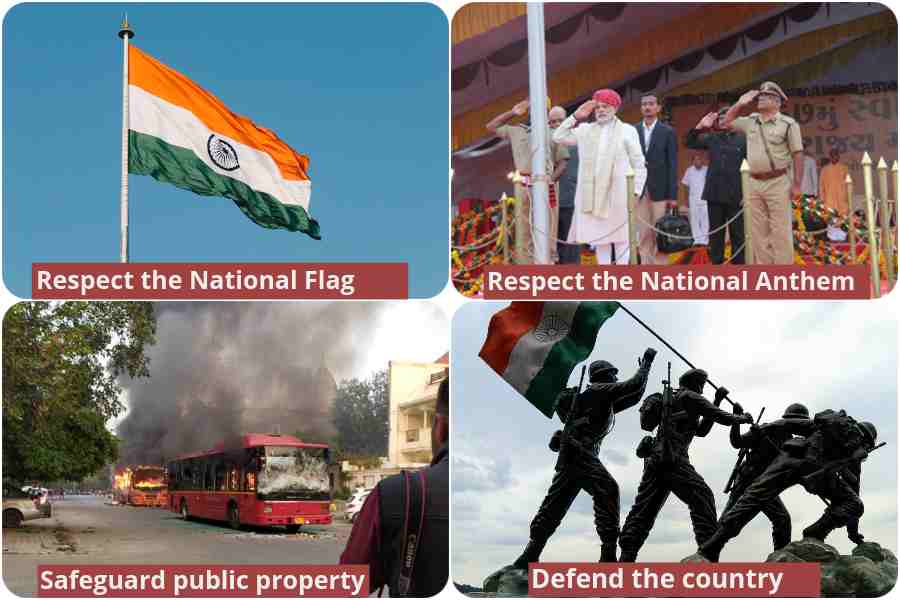
Article 51A: The eleven fundamental duties of every citizen of India-
Article 53: Executive power
Article 54: Election of President The President of India is elected by indirect election, that is by electoral college and consist of
Article 56: Term of Office of President The President's term of office is five years from the date on which he enters upon his office; but he is eligible for re-election. Article 57: Eligibility of re-election of President Article 58: Qualification for election as President
Article 59: Conditions of President office The President shall not be a member of either House of Parliament or of a House of the Legislature of any State. Article 60: Oath or affirmation by the President. Article 61: Procedure for impeachment of the President. Article 62: Time of holding election to fill vacancy in the office of President. A vacancy in the office of president may be caused in any of the following ways
Article 65: Functions of Vice-President If the vacancy in the the office of President by reason of his death, resignation, removal or otherwise, the VIce-President shall act as President until a new President is elected and enters upon his office. Article 66: Election and qualification of Vice-President Article 67: Term of Office of Vice-President The Vice-President's term of office is five years from the date on which he enters upon his office; but he is eligible for re-election. Article 68: Fill vacancy in the office of Vice President Article 69: Oath or affirmation by the Vice-President. Article 70: Doubts and dispute relating to or connected with the election of a President or Vice-President. Article 72: Pardoning power of President
Article 74: Council of Ministers to aid and advise President Article 75: Other provisions as to Ministers.
Article 76: The Attorney-General of India The first Law officer of the Government of India, his duty shall be-

Article 79: Constitution of Parliament. The Parliament of India consists of the President and two Houses. The lower house is called the House of People (Lok Sabha) while the other is known as the Council of States (Rajya Sabha).
Article 80: Composition of the Council of States. The Council of States shall be composed of not more than 250 members of whom
Article 81: Composition of the House of People. The House of People has variegated composition. The Constitution prescribes a maximum number as follows:
Article 83: Duration of Houses Parliament.
Article 84: Qualification for membership of Parliament.
Article 85: Session of Parliament,prorogation and dissolution. The President's power
Article 86: Right of President to address and send messages to Houses. Article 93: Speaker and Deputy Speaker The House of People will, as soon as may be after its first sitting choose two members of the House to be, respectively Speaker and Deputy Speaker. Article 94: Speaker and Deputy Speaker The Speaker or Deputy Speaker will normally hold office during the life of the House, but his office may terminate earlier in any of the following ways.
Article 97: Salaries and allowances of the Chairman and Deputy Chairman and the Speaker and Deputy Speaker. Article 99: Oath or affirmation by members. Article 101: Vacation of seats by members. A member of Parliament shall vacate his seat in the following cases:
Article 102: Disqualifications for membership. A person shall be disqualified for being chosen as, and for being, a member of either House of Parliament
Article 102: Salaries and allowances of members. Article 105: Powers, privileges, etc., of the Houses of Parliament and of the members and committees. Article 108: Joint sitting of both Houses in certain cases. Article 120: Language to be used in Parliament Provided that the Chairman of the Council of States or Speaker of the House of the People, or person acting as such, as the case may be, may permit any member who cannot adequately express himself in Hindi or in English to address the House in his mother-tongue.
Article 153: Governors of States. The executive power of the State is vested in the Government and all executive action of the State has to be taken in the name of the Governor. Article 156: Term of office of Governor. The normal term of a Governor's office shall be five years, but it may terminated earlier, by
Article 157:Qualifications for appointment as Governor. Article 158: Conditions of Governor's office. The Governor of a State is not elected but is appointed by the President and holds his office at the pleasure of the President. Any citizen of India who has completed 35 years of age is eligible for the office, but he must not hold any other office of profit, nor be a member of the Legislature of Union or any State. Article 159: Oath or affirmation by the Governor. Article 161: Powers of Governor The Governor of a State shall have the power to grant pardons, reprieves, respites or remissions of punishment or to suspend, remit or commute the sentence of any person convicted of any offence against any law relating to a matter to which the executive power of the State extends. Article 163: Council of Ministers to aid and advise Governor. Article 164: Other provisions as to Ministers.
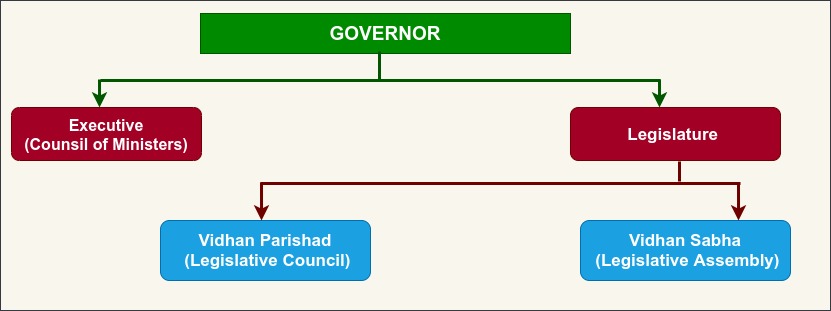
Article 170: Composition of the Legislative Assembly. The Legislative Assembly of each State shall be composed of members chosen by direct election on the basis of adult suffrage from territorial constituencies. The number of members of the Assembly shall not be more than 500 or less than 60. The Assembly in Mizoram and Goa shall have only 40 members each.
Article 171: Composition of the Legislative Council. The total number of members in the Legislative Council of a State having such a Council shall not exceed [one third] of the total number of members in the Legislative Assembly of that State: Provided that the total number of members in the Legislative Council of a State shall in no case be less than 40. Article 172: Duration of State Legislatures. Article 173: Qualification for membership of the State Legislature. A person shall not be qualified to be chosen to fill a seat in the Legislature of State unless he
Article 191: Disqualification for membership. A person shall be disqualified for being chosen as, and for being a member of the Legislative Assembly of Legislative Council of State if he
Article 195: Salaries and allowances of members. Article 212: Courts not to inquire into proceedings of the Legislature. Article 213: Ordinance-making power of Governor.
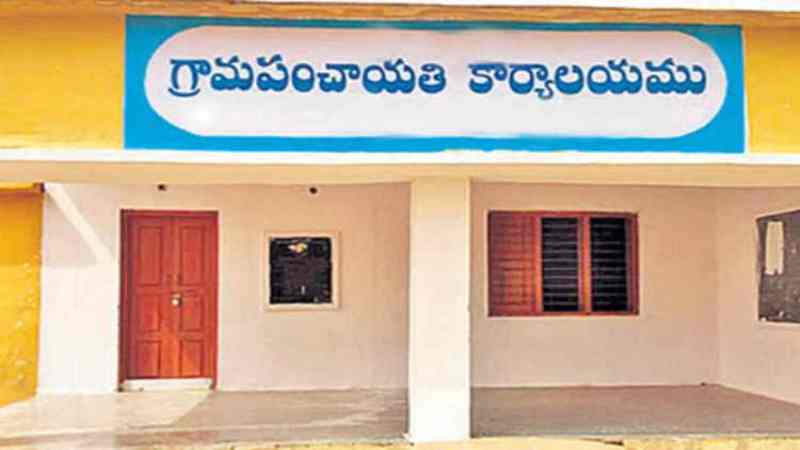
Article 243A: Gram Sabha. A Gram Sabha may exercise such powers and perform such functions at the village level as the Legislature of a State may, by law, provide. Article 243B: Constitution of Panchayats
Article 243C: Composition of Panchayats. All the seats in a Panchayat shall be filled by persons chosen by direct election from territorial constituencies in the Panchayat area and, for this purpose, each Panchayat area shall be divided into territorial constituencies in such manner that the ratio between the population of each constituency and the number of seats allotted to it shall, so far as practicable, be the same throughout the Panchayat area. Article 243D: Reservation of Seats. The seats are reserved for a) Scheduled Castes, and b) Scheduled Tribes. The reservation shall be in proportion to their population. If, for example, the Scheduled Castes constitute 30% of the population and Scheduled Tribes 21%, then 30% and 21% seats shall be reserved for them respectively. Article 243G: Powers, authority and responsibilities of Panchayats State Legislatures have the legislative power, to confer on the Panchayats such powers and authority as may be necessary to enable them to function as institution of self-government. They may be entrusted with the responsibility of
Article 243H: Powers to impose taxes by, and Funds of, the Panchayats. Article 243J: Audit of accounts of Panchayats.
Article 243Q: Constitution of Municipalities There shall be constituted in every State,
Article 243R: Composition of Municipalities. The members of a municipality would generally be elected by direct election. The Legislature of a State may by law provide for representation in a municipality of
Article 243S: Constitution and composition of Wards Committees, etc. Article 243T: Reservation of seats Article 243W: Powers, authority and responsibilities of Municipalities, etc. State Legislatures have been conferred the power, to confer on the Municipalities all such powers and authority as may be necessary to enable them to function as institutions of self-government. It has specifically been mentioned that they may be given the responsibility of
Article 243X: Power to impose taxes by, and Funds of, the Municipalities. Article 243Z: Audit of accounts of Municipalities.
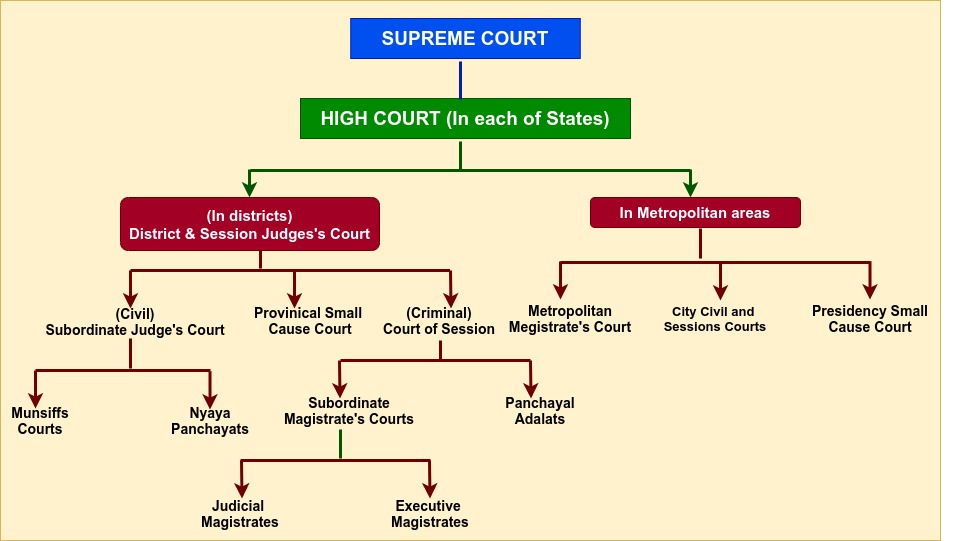
Article 124: Establishment and constitution of Supreme Cour. Article 124A: National Judicial Appointments Commission. Article 124C: Power of Parliament to make law. Article 125: Salaries, etc., of Judges. Article 126: Appointment of acting Chief Justice. Article 134: Appellate jurisdiction of Supreme Court in regard to criminal matters. Article 137: Review of judgments or orders by the Supreme Court. Article 141: Law declared by Supreme Court to be binding on all courts Article 143: Power of President to consult Supreme Court. Article 146: Officers and servants and the expenses of the Supreme Court.
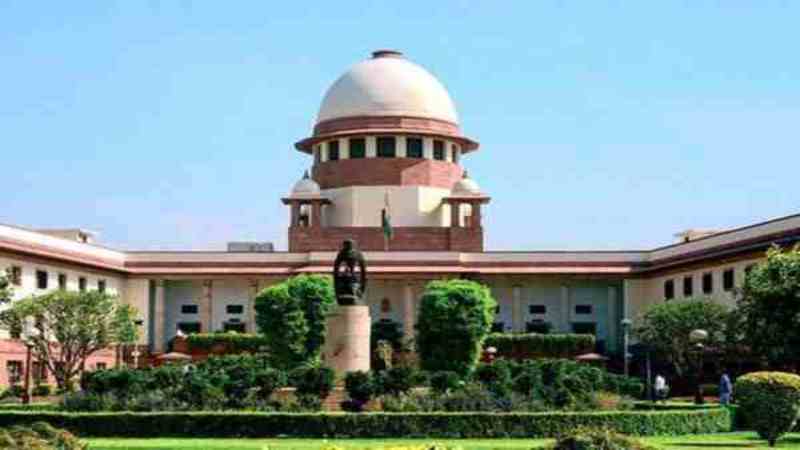
Article 214: High Courts for States. Article 215: Constitution of High Courts. Article 217: Appointment and conditions of the office of a Judge of a High Court. Article 218: Application of certain provisions relating to Supreme Court to High Courts. Article 219: Oath or affirmation by Judges of High Courts. Article 221: Salaries, etc., of Judges. Article 222: Transfer of a Judge from one High Court to another. Article 223: Appointment of acting Chief Justices. Article 227: Power of superintendence over all courts by the High Court. Article 228: Transfer of certain cases to High Court. Article 229: Officers and servants and the expenses of High Courts. Article 231: Establishment of a common High Court for two or more States. Article 234: Recruitment of persons other than district judges to the judicial service.
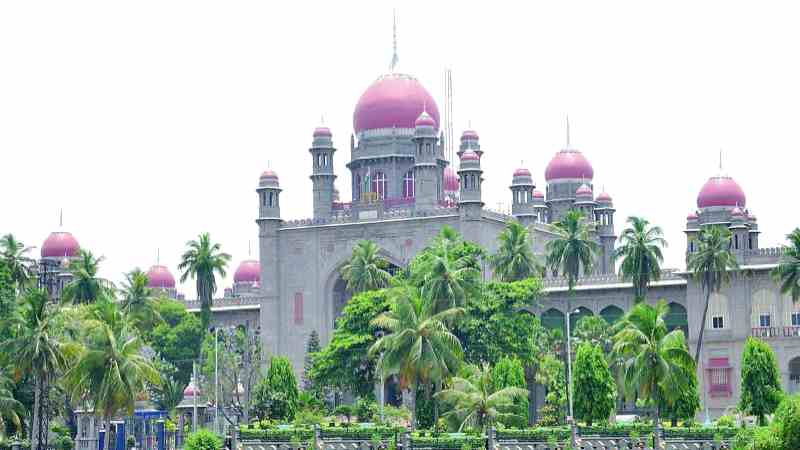
Article 324: Superintendence, direction and control of elections to be vested in an Election Commission. Article 325: No person to be ineligible for inclusion in, or to claim to be included in a special, electoral roll on grounds of religion, race, caste or sex. Article 326: Elections to the House of the People and to the Legislative Assemblies of States to be on the basis of adult suffrage. Article 327: Power of Parliament to make provision with respect to elections to Legislatures. Article 328: Power of Legislature of a State to make provision with respect to elections to such Legislature. Article 329: Bar to interference by courts in electoral matters
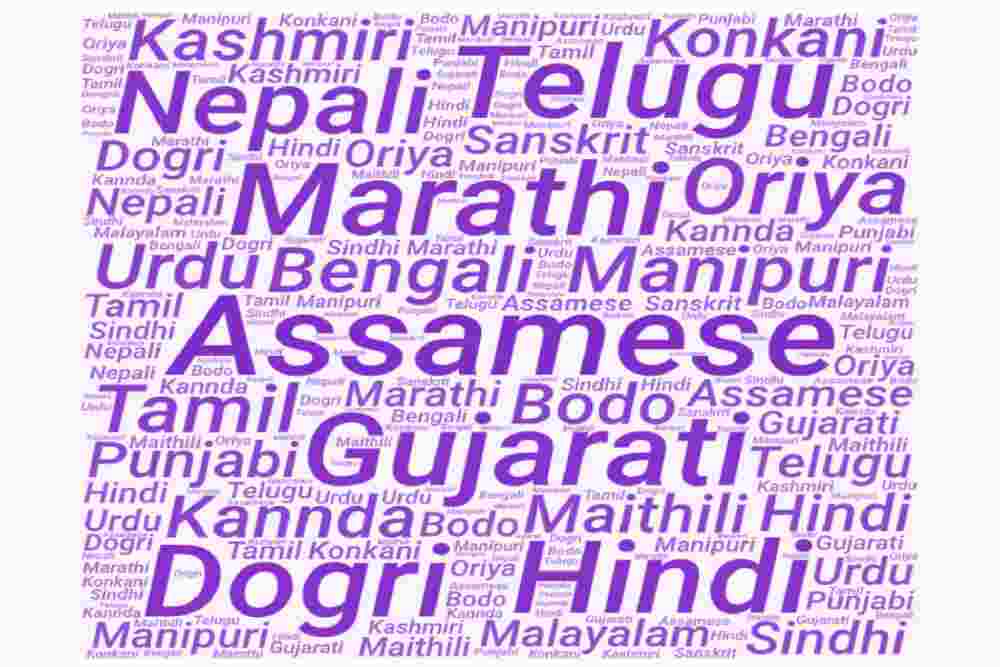
Article 343: Official language of the Union. The official language of the Union shall be Hindi in Devanagari script. But, for a period of 15 years from the commencement of Constitution of India, the English language shall continue to be used for all official purpose of the Union for which it was being used immediately before such commencement. Even after the expiry of the above period of 15 years, Parliament may by law provide for the use of
Article 344: Commission and Committee of Parliament on official language The Constitution of India provides for the appointment of a Commission as well as a Committee of Parliament to advise the President as to certain matters relating to the official language. The official language Commission is to appointed at the expiration of 5 years, and again at the expiration of 10 years, from the commencement of the Constitution of India. The president shall constitute the Commission with the representatives of the recognized language specified in the English Schedule. It shall be the duty of the Commission to make recommendations to the President as to
Article 345: Official language or languages of a State. Article 346: Official language for communication between one State and another or between a State and the Union. Provided that if two or more States agree that the Hindi language should be the official language for communication between such States, that language may be used for such communication. Article 347: Special provision relating to language spoken by a section of the population of a State. Article 348: Language to be used in the Supreme Court and in the High Courts and for Acts, Bills, etc. Article 351: Directive for development of the Hindi language.
The constitution of India is the longest constitution in the world written by Dr. Ambedkar which contains 448 articles in 25 parts, 12 schedules, and 104 amendments. In this article, I focused only on some specific parts which are citizenship, fundamental rights and duties, Government of Union and Government of States, Panchayats, Municipalities, Judiciary (Supreme Court and High Court), Elections and Languages. These terminologies we use on our daily basis and it's better to know about the articles related to it. I hope it helped you get some basics of the Constitution of India.
Note: Please send your suggestions or corrections to info@iplts.com (or Contact us). Thanks for reading this article.
Subscribe for latest news and we respect your privacy
Follow Us